Showing posts with label Vanessa. Show all posts

Wednesday, April 15, 2015

Nessie Review ☆ Fiend

Fiend by Peter Stenson
Publisher: Random House
Release Date: July 9th, 2013
Source: Library
Date Read: 3/18/15 to 3/22/15
295 pages
Rating: ✰✰✰✰


There’s more than one kind of monster.

When Chase Daniels first sees the little girl in umbrella socks tearing open the Rottweiler, he's not too concerned. As a longtime meth addict, he’s no stranger to horrifying, drug-fueled hallucinations.
But as he and his fellow junkies soon discover, the little girl is no illusion. The end of the world really has arrived.

The funny thing is, Chase’s life was over long before the apocalypse got here, his existence already reduced to a stinking basement apartment and a filthy mattress and an endless grind of buying and selling and using. He’s lied and cheated and stolen and broken his parents’ hearts a thousand times. And he threw away his only shot at sobriety a long time ago, when he chose the embrace of the drug over the woman he still loves.

And if your life’s already shattered beyond any normal hopes of redemption…well, maybe the end of the world is an opportunity. Maybe it’s a last chance for Chase to hit restart and become the man he once dreamed of being. Soon he’s fighting to reconnect with his lost love and dreaming of becoming her hero among civilization’s ruins.

But is salvation just another pipe dream?

Propelled by a blistering first-person voice and featuring a powerfully compelling antihero, Fiend is at once a riveting portrait of addiction, a pitch-black love story, and a meditation on hope, redemption, and delusion—not to mention one hell of a zombie novel.

Goodreads | Amazon | B&N | Book Depository


To be honest, outside of The Walking Dead comics I've never really read much zombie fiction. I thought it was cool and provided an interesting background to test humanity and morality and stuff but I never really got too into the whole genre. But look at that summary! An addict making their way through a zombie apocalypse? That's something that I'd definitely heard of or imagined before so I had to check it out.

So the plot has the same straight forward as any other other zombie story--survive. The one key difference is that in addition to food, water, shelter, and guns, our heroes need meth. Throughout this book meth is their number one priority, which is makes sense. Literally the first thing Chase and his friend Typewriter do after figuring out that the end of the world is really happening is drive to their dealers house to see if they can find some meth.


They are so focused in their drive for this drug that we never really learn more about the outside world, and why all this is happening, and the state of everywhere else. We do learn that these zombies are called Chucks because they laugh when they are trying to kill you. But that's really all, nothing about what caused it or anything. However, that didn't bother me at all. That's because it made sense that the characters wouldn't know since they are just concerned about getting their next fix.

This book is written in present tense, so it moves pretty fast but it works. It's even a bit stream of consciousness-like at some points, it's actually really cool to be in the mind of a drug addict like that. Also one thing I liked is that the main character is a HORRIBLE person. He lies, throws his friends under the bus, is self-centered, disgusting...and somehow, I still end up rooting for him and sympathizing with him a tiny bit. It's weird, but cool.

My only complaint is HOW SUDDENLY IT ENDED. LIKE JUST BAM.


But outside of that this is a cool, and really different read you should definitely check out.

Vanessa is Val's bestest buddy, and she will be guest posting throughout because she loves to read and write. She loves video games, reading comic books, working out LIKE A BEAST and photography. You can also find her at her own blog, Musings of an Aspiring Writer.

Monday, April 6, 2015

Nessie Reviews ☆ Bioshock: Rapture

Bioshock: Rapture by John Shirley
Publisher: Tor Books
Release Date: June 26th, 2012
Source: Bought
Date Read: 1/3/15 to 3/15/15
431 pages
Rating: ✰✰✰✰

It's the end of World War II. FDR's New Deal has redefined American politics. Taxes are at an all-time high. The bombing of Hiroshima and Nagasaki has brought a fear of total annihilation. The rise of secret government agencies and sanctions on business has many watching their backs. America's sense of freedom is diminishing…and many are desperate to take that freedom back.

Among them is a great dreamer, an immigrant who pulled himself from the depths of poverty to become one of the wealthiest and admired men in the world. That man is Andrew Ryan, and he believed that great men and women deserve better. And so he set out to create the impossible, a utopia free from government, censorship, and moral restrictions on science—where what you give is what you get. He created Rapture—the shining city below the sea.

But as we all know, this utopia suffered a great tragedy. This is the story of how it all came to be…and how it all ended.


I'm going to be honest, if you haven't played Bioshock I'm not sure if you'll even enjoy this book. I say this because the enter book is pretty much entirely a prequel to the games, meaning that it's a lot of set-up and no real ending. Of course, since I read this as a fan of the series this didn't bother me at all since I know how it all ultimately ends. Instead of reading to find out the ending, I was pretty much reading in order to find out the beginning, if that makes any sense.  And now that I got this mini disclaimer out of the way, on to the review!

Rapture

For those that aren't familiar with the Bioshock series, Rapture is an underwater metropolis created by Andrew Ryan (Yes the similarity to Ayn Rand is intended). He created Rapture to be the ultimate Libertarian dream, where man is free to create whatever he is able to without the constraints of government, or laws, or religion, or anything that might inhibit a man's personal progress. So of course that went just as well as one would have imagined and by the time Bioshock starts, Rapture is a crumbling, lawless, dystopia.

One of my favorite things about the game was trying to uncover the story behind Rapture. Everywhere you wander in that game, no matter how frightening it is, has some sort of beauty and history hidden deep beneath it. And that's what makes this book so awesome because we get to see first hand how this city got so messed up in the first place.

While this book is a story about Rapture, it is more or less framed by Bill McDonagh. Bill was a simple plumber until Andrew Ryan took a liking to him and made him his right-hand hand in Rapture. Bill was enamored with the vision that Ryan presented--a place where a man can truly make himself into whatever he wishes--but soon found himself disillusioned and heartbroken as he saw the hell that Rapture descended into.

One thing that I did appreciate as a fan of the series is how this book kind of humanized Andrew Ryan for me. Throughout this book we see a man who has a vision and wants so hard to make it work. Even if it involves horrible things like not allowing a social safety net for the poorer citizens even when he sees first hand how dire their situation is. While it is crappy of him, he does it because he whole-heartedly believes in a man's ability to pull themselves up by their bootstraps, even though its not as simple in reality as one might like to think. If anything, it painted him in a bit more sympathetic light, a man who was so blinded by his beliefs that he willingly ignored the hell they created in front of him

I will say that even as a big fan of this series, I found the book to be a bit long and uninterested in times. So I would put it down and read other books while reading this one. I still would recommend this book to you if you are a fan of the Bioshock series. If you aren't it's still a good a read, I'm just not sure if you would appreciate it or be satisfied with the ending.

Vanessa is Val's bestest buddy, and she will be guest posting throughout because she loves to read and write. She loves video games, reading comic books, working out LIKE A BEAST and photography. You can also find her at her own blog, Musings of an Aspiring Writer.

Monday, March 30, 2015

Nessie Reviews ☆ Redwall

Redwall by Brian Jacques
Redwall #1
Publisher: Penguin
Release Date: October 4th, 2007
Source: Library
Date Read: 3/6/15 to 3/14/15
352 pages
Rating: ✰✰✰✰

Redwall Abbey, tranquil home to a community of peace-loving mice is threatened by Cluny the Scourge - the evil-one-eyed rat warlord - and his battle-hardened horde of predators. Cluny is certain that Redwall will fall easily to his fearsome army but he hasn't bargained for the courage and strength of the combined forces of the Redwall mice and their loyal woodland friends.


I actually got a solid 15 books into this series when I was in middle school. And since I'm older and wiser I figured a re-read was in order. This book is every bit as awesome as I remember.

There is literally no reason for you not to read it. I love everything about it. There are adorable mice and woodland critters doing cute things that literally had me saying "aww" as I read. The plot is pretty simple. Redwall Abbey is the home of the peaceful monk mice and they take care of and live happily with the surrounding woodland critters. Then an evil rat called Cluny the Scourge shows up, decides he wants Redwall and begins a siege. The main character is Matthias, a young mouse who steps up and becomes the warrior that Redwall needs. However this is as much a story of the place and the other creature's relationship to and love of it, as much as it's about Matthias's hero journey. 

Also the women characters are awesome and important and diverse and just as important as the male characters. I love how there is Constance the Badger who is all muscle and stuff, but theres also Cornflower who spends most of her time in the kitchen cooking and taking care of Redwall while everyone is fighting, and Jess the Squirrel who is a mother but is still kicking ass. LIKE IT SHOWS THAT WOMEN CAN BE STRONG AND EVERYTHING NO MATTER WHAT THEY DO AND YASS. I really like that because while I do love strong female characters, I feel like people seem to think that a woman can only be strong if they are like Constance, on the front lines in the "man's" realm, but I love love LOVE how this shows that women can be strong and badass even when they are in traditional women roles. 


I loved all the characters and how unique they all were and the world building that went into it, and how well written it is. The only criticism I could see one making is that like the morality is so black and white--the villain is super evil and the good guys are obviously good--but I personally didn't find that to be a problem at all because 1) its a kids book 2) it's still so awesome.

So if you want to spend a few hours with ADORABLE anthropomorphic woodland critters, meet some of the most awesome characters, soak up some good writing, and just have a good read. DEFINITELY pick this up.

Vanessa is Val's bestest buddy, and she will be guest posting throughout because she loves to read and write. She loves video games, reading comic books, working out LIKE A BEAST and photography. You can also find her at her own blog, Musings of an Aspiring Writer.

Monday, March 16, 2015

Nessie Reviews ☆ Museum of Intangible Things

The Museum of Intangible Things by Wendy Wunder
Publisher: Penguin
Release Date: April 10th, 2014
Source: Library
Date Read: 2/28/15 to 3/5/15
304 pages
Rating: ✰✰✰


Loyalty. Envy. Obligation. Dreams. Disappointment. Fear. Negligence. Coping. Elation. Lust. Nature. Freedom. Heartbreak. Insouciance. Audacity. Gluttony. Belief. God. Karma. Knowing what you want (there is probably a French word for it). Saying Yes. Destiny. Truth. Devotion. Forgiveness. Life. Happiness (ever after).

Hannah and Zoe haven’t had much in their lives, but they’ve always had each other. So when Zoe tells Hannah she needs to get out of their down-and-out New Jersey town, they pile into Hannah’s beat-up old Le Mans and head west, putting everything—their deadbeat parents, their disappointing love lives, their inevitable enrollment at community college—behind them.

As they chase storms and make new friends, Zoe tells Hannah she wants more for her. She wants her to live bigger, dream grander, aim higher. And so Zoe begins teaching Hannah all about life’s intangible things, concepts sadly missing from her existence—things like audacity, insouciance, karma, and even happiness.

The cover of this book lied to me. I picked it up expecting a sort of cute hipstery light read about some girlfriends doing fun stuff on a road trip. Instead I was treated to a story that dealt with bad parents, an alcoholic father, lower-middle class struggles with money, and the toll mental illness can take on a person and their relationships. So be warned, if you pick this up don't be expecting a light-easy read.


I'm not giving anything away when I say that Zoe has bipolar disorder, you find out within the first chapter. And I think, even though it's told from Hannah's point-of-view, that this book is more about Zoe, her disorder, and how it affects their friendship. Hannah and Zoe are pretty much exact opposites. Hannah is firmly rooted in her place in life, and cares about her parents to the extent that she's more or less taking care of them instead of them taking care of her. Zoe on the other hand, possibly due to her manic tendencies, is much more impulsive, confident, and everything Hannah is not.

I really appreciated this book's portrayal of mental illness. It doesn't shy away from the debilitating effects of mental illness, and doesn't try to romanticize it in anyway. We saw Hannah both in her manic and in her depressive phases, and how terrifying both stages can be. Initially it was just little offhand remarks and things that made me aware that it was just there in the background. One example is earlier one after Zoe is coming out of a bad depressive phase, Hannah hugs her and mentally makes a note of being able to feel her collar-bone, alerting her that Zoe was doing that "not eating thing again". As the story goes on and her illness became more important to the story more time was spent exploring it, but I just really appreciated all the little realistic hints that were scattered throughout the story.

I also liked how this book portrayed friendship. Hannah and Zoe are without a doubt the most important person and each other's lives, and the book doesn't just simply tell us that. It SHOWS us it so, so well. And I love how Hannah is understanding of Zoe's illness, and does her best to help her in her own way. However, without giving too much away, there came a point during this road trip that I thought that Hannah was too much of an enabler, and could have done more to help, even if caused Zoe to mad at her. Because this trip started out as a way for them to clear their heads from their crappy town and situations at home, but eventually I began feeling that Hannah should have put her foot down. And this is one of the main reasons I only gave this book 3 stars.

Also theres this side romantic plot line that Hannah has with some dude she's been crushing on since she was like seven and I just didn't see the point in it at all.


He is literally a manic pixie dream boy and I just couldn't stand it. He seems to serve no real purpose other than making Hannah feel better and he's too perfect and bland that it's annoying. And theres a point when Zoe, who's an a severe manic state and is most definitely a danger to herself, goes missing for a bit. AND HANNAH AND HER BOYTOY STOP TO DO THE FRICK-FRACK THE BACK OF THE CAR AND I'M JUST LIKE IS THIS SERIOUSLY THE TIME TO BE DOING THAT???

Ugh. Those were my two main complaints with the book. It's an okay read, I would say read if for its portrayal of friendship and mental illness. It is a good story but just the fact that Hannah couldn't keep it in her pants annoyed the crap out of me. You guys should read this book and tell me what you think about it!
Vanessa is Val's bestest buddy, and she will be guest posting throughout because she loves to read and write. She loves video games, reading comic books, working out LIKE A BEAST and photography. You can also find her at her own blog, Musings of an Aspiring Writer.

Wednesday, March 4, 2015

Nessie Reviews ☆ Peeps

Peeps by Scott Westerfeld
Peeps #1
Publisher: Penguin
Release Date: February 3rd, 2005
Source: Library
Date Read: 2/8/14 to 2/24/14
312 Pages
Rating: ✰✰✰✰


Last year as college freshman, narrator Cal was infected by exotic goth Morgan with a parasite that caused following girlfriends to become vampire-like ghouls he calls parasite-positives "Peeps". A carrier without symptoms, he hunts his progeny for the centuries old bureaucratic Night Watch. But victims are showing more sanity, pretty human Lacey is pushing his buttons, and her apartment building basement houses fierce hordes of ravening rats, red-eyed cats, and monstrous worms that threaten all. Morgan has the secret to a centuries-old conspiracy and upcoming battle to save the human race.


Goodreads | Amazon | B&N | Book Depository

You know how back in the days before science when strange things happened humans would make up elaborate stories to explain it? Droughts happened because the gods were upset, a child was born blind because of the father's sins, epilepsy was obviously just someone being possessed. Now imagine that is the same thing that happened with vampires. Vampires never really existed...well they do, but instead of being some mystical creature they're just normal humans who are showing symptoms of a sickness. Welcome to the world of Peeps.

No not those peeps
In this book, vampirism is a result of infection from a parasite and those who are infected are referred to as parasite-positive, or, for the sake of brevity, as  peeps. And this parasite is spread by the exchanging of bodily fluids. Yes, so vampirism is basically an STD. 

The story revolves around Cal Thompson, a 19 year-old Texas native who, on his first night in New York City, had a one-night stand that left him with a new parasite friend. However, he's special in that he's a carrier. A carrier is someone who is infected with the parasite and gets all the cool super cool side-effects, but doesn't become a brainless bloodsucker hiding from the light. He works for the City Nightwatch, which is a secret branch of the NYC government that deals with keeping the parasite under control, and learning more about it. 

As a newly infected carrier, Cal's first missions involve hunting down the girls he has unknowingly infected within the past year. The book begins with him tracking and capturing his ex-girlfriend Sarah. After successfully dealing with her, he decides to try and hunt down the woman who infected him in the first place. While doing this he teams up with Lace, a journalism students who he's forced to reveal his secret to, and discovers that his strain of the parasite is much bigger than he could have ever imagined.

Outside of the unique explanation, there were two main things that I really liked about Westerfeld's take on vampirism. The first is how he touches on having the parasite is isolating. Since the parasite wants to spread to new hosts, people infected with it are extremely, extremely horny, but on the flip side, they know that they can't act on those urges. Cal often expresses his frustration at not even being able to get close to another girl, or kiss another human being again, which makes me feel for the kid a bit.


The other was the concept of the anathema. When someone becomes infected with the parasite they begin to detest and fear the things they loved most or were exposed to a lot when they were human. This explains why people often thought that vampires were weak against crosses. Because during the last bad outbreak of the parasite, humans were in a very religious environment,  constantly with crosses and religious imagery. So when those humans became peeps they would flee from the sight of crosses, not because cross itself held come magical power, but because it reminded them too much of their human life. 

Finally, every even numbered chapter gives you a brief biology lesson on a different parasite. They seem a bit pointless at first, even though they are quite entertaining. But as the book continues you begin to understand why they are there. Even though we thing parasites are just complete nuisances and should be all eradicated, these even numbered chapters help you understand just how essential they are for the world and can even be helpful at times. And this takes on a deeper significance with some of the things that happen in the last third of the book.

Overall, this is a pretty cool book and you should check it out. 

Vanessa is Val's bestest buddy, and she will be guest posting throughout because she loves to read and write. She loves video games, reading comic books, working out LIKE A BEAST and photography. You can also find her at her own blog, Musings of an Aspiring Writer.

Monday, January 5, 2015

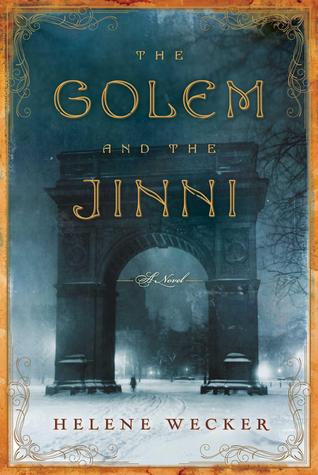
Nessie Reviews ☆ The Golem and the Jinni

The Golem and the Jinni by Helene Wecker
Publisher: HarperCollins
Release Date: April 23rd, 2013
Source: Bought
Date Read: 11/29/14 to 12/30/14
496 Pages
Rating: ✰✰✰✰

Chava is a golem, a creature made of clay, brought to life by a disgraced rabbi who dabbles in dark Kabbalistic magic. When her master, the husband who commissioned her, dies at sea on the voyage from Poland, she is unmoored and adrift as the ship arrives in New York in 1899.

Ahmad is a jinni, a being of fire, born in the ancient Syrian desert. Trapped in an old copper flask by a Bedouin wizard centuries ago, he is released accidentally by a tinsmith in a Lower Manhattan shop. Though he is no longer imprisoned, Ahmad is not entirely free – an unbreakable band of iron binds him to the physical world.

The Golem and the Jinni is their magical, unforgettable story; unlikely friends whose tenuous attachment challenges their opposing natures – until the night a terrifying incident drives them back into their separate worlds. But a powerful threat will soon bring Chava and Ahmad together again, challenging their existence and forcing them to make a fateful choice.


Hey it's been a while, but I'm back and doing reviews for my dear bud Val, so expect to see a lot more of me this year!


This book was magical, touching, charming, and realistic all at once. I followed the lives of two mythical creatures as they made their way in late 19th century New York, and simultaneously found myself questioning some of silly things inherent in human nature. I loved this book. 

Chava is a golem, a creature made of earth and clay that was brought to life by her master on a voyage across the Atlantic. A golem is created in order to serve their master and can look into their minds and hear their desires. However her master died shortly after, leaving her alone and overwhelmed in New York city as her head is constantly filled with the wants, wishes, and hopes, of everyone in the city. Eventually she runs into a Jewish rabbi that takes her under his wing and teaches her how to pass as a human. 

Ahmad, is a jinni and the exact opposite of Chava. While Chava is essentially a child, the Ahmad is hundreds of years old. Chava is timid, cautious, and wants to help others, while Ahmad is a bit selfish, hedonistic, and cares little for how his actions might affect others. A golem is created by humans for the purpose of serving while jinnis have no master and even look down upon humans. Chava is made of earth while Ahmad is a being of fire untethered by anything. Well...until he got tricked into captivity by a wizard many, many years ago. Somehow his lamp ended up in a Syrian immigrant's tinsmith shop, and when he goes to fix it, the jinni is released. Used to a life of flitting from one pleasure to another he is greatly irritated by his new captivity as he begins to make a life for himself.

While Chava and Ahmad are the main characters, the story is told from many point of views and we are introduced to many characters. Initially, this diversions feel like little mini-side stories, introducing me to people in different countries or giving me a history and a minor character I had met earlier in the story. However, it didn't detract from the story at all for me, I was excited to learn about all these characters. It's not until closer to the end of the novel that I began to understand these character's importance to Chava and Ahmad's story. Overall the author has a masterful control over the story and I always felt safe in her hands. 

The only downside is that I felt like it took a lot of time for an actual plot to emerge. It was like two-thirds of the book was spent just observing Chava and Ahmad struggle and discover their way in New York city--which I didn't mind at all, because as I said earlier I loved them as characters. When the plot did finally show up it felt a bit rushed in comparison to the rest of the book. Which didn't bother me too much because THAT PLOT TWIST THOUGH OMG


In addition to the magical story, this book paints a realistic picture of the immigrant experience which I really enjoyed. It also left me pondering on some aspects of human nature, like why we cling to religion, or why we often don't act on our innermost desires, or why we risk so much for love.

I highly, highly recommend this book. It's not often I'd use the words quaint or charming or sweet to describe a book, but I feel they describe this book perfectly. Read it you won't be disappointed! I'll leave you with one of my favorite quotes from it.

He drew her close, the crown of her head beneath his cheek. Beyond the hansom's window, New York was an endless rhythm of walls and windows and doors, darkened alleys, flashes of sunlight. he thought, if he could pick a moment to be taken into the flask, a moment to live in endlessly, perhaps he would choose this one: the passing city, and the woman at his side.” 


Vanessa is Val's bestest buddy, and she will be guest posting ooccasionallybecause she loves to read and write. You can also find her at her own blog, Musings of an Aspiring Writer.

Friday, August 29, 2014

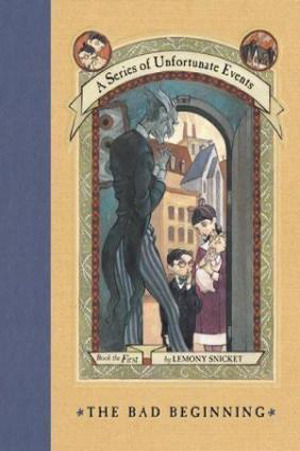
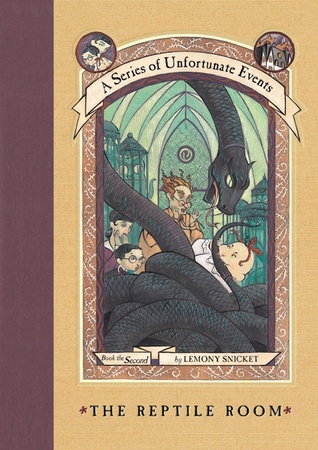
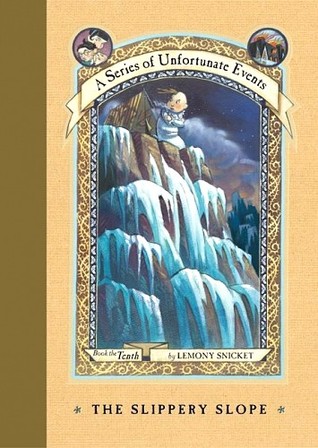
Nessie Reviews ☆ A Series of Unfortunate Events


A Series of Unfortunate Events

Number of Books: 13
Publisher: HarperCollins
Release Date of First Book: September 30th, 1999
Release Date of Last Book: October 13th, 2006

The executor of the Baudelaire estate -- a phlegm-plagued banker named Mr. Poe - sends the children to live with a distant relative: a conniving and dastardly villain named Count Olaf, who has designs on the Baudelaire fortune. Count Olaf uses the children as slave labor, provides horrid accommodations for them, and makes them cook huge meals for him and his acting troupe, a bunch of odd-looking, renegade good-for-nothings. When the children are commandeered to appear in Count Olaf's new play, they grow suspicious and soon learn that the play is not the innocent performance it seems but rather a scheme cooked up by Olaf to help him gain control of the children's millions.

All this bad luck does provide for both great fun and great learning opportunities, however. Violet is a budding McGyver whose inventions help the children in their quest, Klaus possesses a great deal of book smarts, and Sunny -- whose only real ability is an incredibly strong bite -- provides moral support and frequent comedy relief. Then there are the many amusing word definitions, colloquialisms, clichés, hackneyed phrases, and other snippets of language provided by the narrator (a character in his own right) that can't help but expand readers' vocabularies. Though the Baudelaire children suffer myriad hardships and setbacks, in the end they do manage to outsmart and expose Olaf's devious ways. But of course, with luck like theirs, it's a given that Olaf will escape and return to torment them again some day. If only misery was always this much fun.


When I was little, my school's library had the Series of Unfortunate Events series, but they had two red dots on their spines. One read dot meant that you had to be at least in sixth grade to check it out, and two red dots meant that only eighth graders could check it out. However, by the time I reached sixth grade, I realized that the local public library had no such age restrictions and read the entire series within a month. I thoroughly enjoyed the series, but I didn't quite understand why the series was restricted to the older kids. Yes, it was a bit sad at times, but nothing my little eleven year old self couldn't endure.

However, having read it for the second time--this time at twenty years old, I can wisely say that my eleven year old self was dead wrong. I don't know what I missed as a kid but these books are SO FRICKING DEPRESSING. For example, the series opens with the Violet, Klaus, and Sunny Baudelaire's lovely day at the beach being interrupted by the news that their house burnt down in a fire that also claimed the lives of their parents. Did I mention that their respective ages are 14, 12, and under 1?


Anyways, after getting this news the orphans are placed in the custody of Count Olaf, who is their "third cousin four times removed or fourth cousin three times removed" according to Mr. Poe, the incompetent banker in charge of the Baudelaire fortune until Violet turns eighteen. However, after spending some time at his filthy mansion, the orphans discover that Olaf is only after their fortune. I really don't want to give too many spoilers away in this reviews, but the Baudelaires are able to stop his scheme and placed in the custody of another guardian. But Olaf is not so easily assuaged and hunts them down and comes up with a scheme to once again steal their fortune. And this is pretty much the formula for the first few books: orphans arrive in custody of an eccentric new guardian, things are relatively okay (sometimes not) as they adjust, Olaf shows up and causes trouble and/or deaths, then the kids are shipped off to another home. 

While this formula is quite obvious for the first seven books, it doesn't get tiring at all. Each new guardian is more absurd and quirky than the last. In the third book, The Wide Window, they are put under the care of their Aunt Josephine who is cripplingly afraid of everything. For example, the kids can't even turn on a stove to heat up food because she's terrified it might result in the house burning down. But outside of those, she is truly a loving guardian. They spend the fifth book, The Austere Academy, at a boarding school that has teachers who give the Baudelaire's a hard time because their orphans and where Sunny (the baby) is forced to become a secretary for the principal. However, while there they meet another set of orphans, the Quigley's who become very important as more secrets are discovered in the series. The Vile Village takes the saying "It takes a village to raise a child" proverb literally and the orphans spend the seventh book in the legal care of an entire (and quite strange) village. 

The ending of The Vile Village also drastically changes the tone and direction for the remaining books of the series. The Baudelaire orphans are framed for a crime that they did not commit and must spend the remaining books on the run as they try to discover more about the mysterious V.F.D-- a secret organization of which many characters they encounter (and their late parents) are members. There are so many questions that are raised in the second half of the book such as: what is the connection between the Quigley's and the Baudelaires? Why does Count Olaf harbor such a deep grudge against the Baudelaires? What exactly is V.F.D and what happened to it? What is the sugar bowl and why is it so damn important? And many, many other questions since the second half of the series isn't just about the Baudelaires but is also about V.F.D and the other characters they encounter.

Their motto and symbol

 However I'm sad to report that not all these questions get answered. The Baudelaire's chapter of the story get full closure (for the most part), but the larger story of which they only play a part, doesn't really get answered. And while reading, it's clear that it's not a result of laziness on the part of the author--he knows everything, but just isn't telling. It is a bit frustrating having all these questions that never will get answered, but I promise you this series is still worth a read. So I guess I'll talk about the things this series does right.

One aspect of the series that I appreciated a lot as an adult was the moral ambiguity. In the beginning, good and evil is as defined as black and white--which was something that I expected of a children's book. However as the series goes on, determining who or what is good and bad is not as simple anymore. Especially since the Baudelaires are forced to do things that are clearly quite horrible (especially in The Penultimate Peril--Book 11 >.<), but they are still good kids and those things were only done in order to protect themselves. A character in the tenth book, The Grim Grotto, says it the best:

People aren't either wicked or noble. They're like chef's salad, with good things and bad things chopped and mixed together in a vinaigrette of confusion and conflict

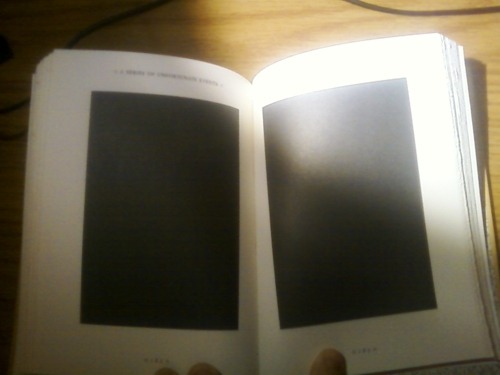
In addition, Lemony Snicket is the best narrator--his writing style is so unique and mature that you won't even feel like you're reading a children's book. He spends a good amount of each book urging you not to read it because of how depressing the subject matter is and has the best sense of dry humor. I guess the best way to say it is that he doesn't seem to care what he does, but that's not quite getting at it, so I'll try giving some examples. In the sixth book, The Eratz Elevator, there a a few pages that are just black, in order to show just how dark the environment was for the orphans at that point in the book.

Who cares about saving trees anyways.
There is a point The Bad Beginning when Klaus, the bookworm up late at night reading a book, and Lemony Snicket writes this.

The book was long, and difficult to read, and Klaus became more and more tired as the night wore on. Occasionally his eyes would close. He found himself reading the same sentence over and over. He found himself reading the same sentence over and over. He found himself reading the same sentence over and over.
And, my personal favorite (which technically is not from the Series of Unfortunate Events series, but it's still amazing) 

If writers wrote as carelessly as some people talk, then adhasdh asdglaseuyt[bn[ pasdlgkhasdfasdf. ~Horseradish
However, in addition to writing ridiculous sentences like these he also manages to write some of the most true things that I have ever read

“The way sadness works is one of the strange riddles of the world. If you are stricken with a great sadness, you may feel as if you have been set aflame, not only because of the enormous pain, but also because your sadness may spread over your life, like smoke from an enormous fire. You might find it difficult to see anything but your own sadness, the way smoke can cover a landscape so that all anyone can see is black. You may find that if someone pours water all over you, you are damp and distracted, but not cured of your sadness, the way a fire department can douse a fire but never recover what has been burnt down.” ~The Bad Beginning

So this post is already much longer than normal so I'm going to cut myself off here, but let it be said that I have not even covered half of what makes this series so amazing for me. There is so much more about the plot that could be said, so many unique characters that I've fallen in love with, and so many quotes that I am dying to share with you. However, I shall cut myself here in hopes that you will take it upon your self to read this wonderful series, I can promise you that you will not regret it.


Vanessa is Val's bestest buddy, and she will be guest posting throughout the summer because she loves to read and write. You can also find her at her own blog, Musings of an Aspiring Writer.

Wednesday, August 20, 2014

Nessie Reviews ☆ The Case-Book of Sherlock Holmes

The Case-Book of Sherlock Holmes by Sir Arthur Conan Doyle
Publisher: Little, Brown Company
Release Date: 2004
Source: Bought
Date Read: 8/23/13 to 8/15/14
303 Pages
Rating: ✰✰✰


The last twelve stories written about Holmes and Watson, these tales reflect the disillusioned world of the 1920s in which they were written. Some of the sharpest turns of wit in English literature are contrasted by dark images of psychological tragedy, suicide, and incest in a collection of tales that have haunted generations of readers.


Goodreads | Amazon | B&N | Book Depository

I impulse bought this from a local bookstore in New York half-way through my Freshman year because I was really upset about BBC's Sherlock hiatus and wanted something to fill the void, so I figured reading the original Sherlock would be the best way to satisfy my craving.

Two things I need to let you guys know up front before getting into the review: 1) I read this book on and off over the course of a year. I treated it more as a filler book when I wasn't able to get my hands onto anything else. 2) I didn't realize these were the last Sherlock stories until after I finished reading it and checked its Goodreads page, because I'm just a genius like that. 


This is the perfect time to mention that I DETEST reading things out of chronological order
Anyways, this collection contains the final twelve adventures of Sherlock and his dear Watson. Of these twelve my favorite was "The Problem of Thor Bridge" because of the twists and turns the case took, the motive of the culprit, and just how it all came from an unfortunate misunderstanding. This is not to say that the other cases weren't as engaging (I also thoroughly enjoyed "The Adventure of the Retired Colourman" and "The Adventure of Lion's Mane"), it's just that in general I don't find most British works written in the late 1800's to early 1900's as engaging or interesting as other books that I read. I think it just something to do with the language and the way it's written that I think creates some distance between me and the story--and it's the only reason that I gave this collection 3 stars. Actually...the more I think about it, I think the style just reminds me too much of the books I was required to read, but cared little for throughout high school and college.

That being said, Sir Conan Doyle is an excellent writer. He's not as flowery or beautiful as Fitzgerald (one of my favorite writers) in his writing, but he exerts quiet kind of control that I really enjoyed. I guess the best example of this is through his descriptions of the various characters. When a new character entered I would immediately visualize them in one way or another. However, over the course of a couple paragraphs or pages Doyle would quietly drop the occasional adjective or note about their demeanor, that made me revise my mental image of them. These little revisions were done so discreetly that it wasn't until the character left the scene that I would realize just how drastically my imagining of them had changed. Even outside of character descriptions, throughout reading I felt comfortable that my narrator was in complete control of the story and would gently guide me along where I needed to go.

Also, I was pleased to see that Sherlock was just as much as an immature,

"The good Watson had at that time deserted me for a wife, the only selfish action I can recall in our association."
sassy little twat,

"On my word, Watson, you are coming along wonderfully. You have done very well indeed. It is true you have missed everything of importance, but you have hit upon the method..."

that is in love cares deeply for his good friend Watson,

"'You're not hurt, Watson? For God's a sake, say that you are not hurt!'
It was worth a wound--it was worth many wounds--to know the depth of loyalty and love which lay behind that cold mask. The clear, hard eyes were dimmed for a moment, and the firm lips were shaking. For the one and only time I caught a glimpse of a great heart as well as of a great brain. All my years of humble but single-minded service culminated in that moment of revelation."

that I remember from BBC Sherlock.


So if you've only ever heard of Sherlock Holmes, but never actually read any of the book give it a shot! However, don't make the same dumb mistake I did and actually start with the first Sherlock story, titled A Study in Scarlet.


Vanessa is Val's bestest buddy, and she will be guest posting throughout the summer because she loves to read and write. You can also find her at her own blog, Musings of an Aspiring Writer.

Sunday, August 17, 2014

Nessie Reviews ☆ Ebony Rising

Ebony Rising: Short Fiction of the Greater Harlem Renaissance by Craig Gable
Publisher: Indiana University Press
Release Date: February 1, 2004
Source: Library
Date Read: 7/11/14 to 8/11/14
600 Pages
Rating: ✰✰✰✰


Ebony Rising is the first comprehensive, gender-balanced collection of short fiction from the greater Harlem Renaissance era (1912-1940). This was a time marked by writing of extraordinary breadth and depth by some of the most famous authors in African American literary history. Among them were Langston Hughes, Zora Neale Hurston, Jean Toomer, Dorothy West, and Claude McKay. Not surprisingly, these authors have received an unprecedented amount of critical attention, and their work remains popular to this day.

For this anthology, Craig Gable has selected 52 short stories by 37 writers (20 women and 17 men) representing a wide range of style, form, subject matter, and social awareness. To underscore the movement's growth and change, the stories are arranged chronologically by year of publication. Some will be familiar to readers; many more will not, for this is not the "greatest hits" of the Harlem Renaissance. Instead, readers will find a remarkable collection of fiction by authors famous and obscure--some who lived in New York City and others who never resided there. There are stories set in Harlem, but they are just as likely to take place elsewhere in the United States. Alongside traditional stories, there are examples of detective fiction, political satire, even science fiction, with a few experiments in narrative structure and form for good measure. The stories take up issues of race, marriage, parenthood, crime, politics, religion, work, abuse, old age, and death--in short, the stuff of life, and of compelling and lasting fiction.


When this summer started, I challenged myself to read a few books that were outside of my usual reading range. In addition, throughout the past year I have become increasingly aware of the importance of reading and listening to marginalized voices. Growing up I had always been vaguely aware of what the Harlem Renaissance was and its cultural importance for Black Americans but never really read anything from it. However after spending 3 or 4 days a week in Harlem for my job (I  go to school at Columbia University--just a couple blocks away), I had a burning desire to read and learn more about the area's cultural history. So when I stumbled across this 600 page behemoth in my local library I knew I had get my hands on it.


This was my first time reading an anthology so I can't really compare it as a whole work against other anthologies. That being said, the reason I picked up this particular anthology is because the editor, Craig Gable, made a point to include women, lesser known authors, and a variety of genres. I thought it would give me a nice wide scope of what Black American authors were writing. I also skimmed through the introduction, where Mr. Gable made a point to mention the importance of the works being arranged by date published instead of by authors. If anything, I liked this arrangement because it allowed me to see which fears and social circumstances changed or remained the same across these works.

This anthology is made up of 52 short stories, but, of course, some stood out to me more than others. One story that will always haunt me is "The Closing Door" by Angeline Weld Grimké. In it, a fifteen year old girl paints the picture of a beautiful, happy, ideal life with her with an aunt and uncle, Agnes and Jim Milton, that couldn't be more in love and are expecting a beautiful baby. However, the mood drastically changes as Agnes discovers that her favorite brother was lynched by a mob in the South. The woman who was once the epitome of joy and light is transformed into a ghost that lurks along the shadows. Once so happy to be a mother, she is now distraught at the thought of bringing life into the world when any "orderly, white mob" could murder her child and no one would think twice. The way Grimké tells this story is equally beautiful and heartbreaking and actually forced me to put down the book for a couple days just so I could soak it all in and realize just how relevant a story written in 1919 is today.

Me after finishing 70% of the stories
I'm not going to lie, a fair amount of these stories are depressing. Many of them involve characters who are trying their hardest to better their lives but continue to find themselves exploited or at the bottom for no other reason than the color of their skin. While lynchings are discussed, they mainly remain in the background giving you a glimpse into the world and the constant, yet normalized, fear that Black Americans once lived under. There's once sci-fi story written by W.E.B Dubois, where the entirety of New York City has been suddenly killed with the exception of Jim, a black man, and Mary, a white woman. It was interesting to see how it took the apparent erasure of society for Jim to be seen as a man once again. However, let it be said that there are also a few works in here that aren't too concerned with the racial politics of the day but are just as fun and interesting to read. There's also a murder mystery story that isn't too concerned with the social politics of the day and was just a nice distraction.

I highly recommend this anthology for everyone to read just because I think it is extremely important to read from authors that have been silenced or marginalized in the past. Some of the works in this anthology force you to face the parts of America's past that we so often try to forget. It's horrendously uncomfortable at times, but I still find it necessary, because you can't claim to know or love your country if you don't ever encounter it at its worse.

Take the Red Pill and read this book.

Vanessa is Val's bestest buddy, and she will be guest posting throughout the summer because she loves to read and write. You can also find her at her own blog, Musings of an Aspiring Writer.
This site uses IntenseDebate to manage comment data. Learn more about how that is processed here.